About FENITH
FENITH represents a groundbreaking initiative in healthcare data analysis, leveraging federated learning techniques to enable collaborative research across Italian healthcare institutions while maintaining the highest standards of data privacy and security.
Our framework facilitates the development of sophisticated machine learning models through distributed computation, allowing healthcare providers to contribute to collective knowledge without compromising sensitive patient information.
Privacy-Preserving Architecture
Advanced federated learning protocols ensure sensitive medical data never leaves local institutions while enabling collaborative model training.
Standardized Integration
Seamless integration with existing healthcare information systems through standardized protocols and interfaces.
Research Impact
Facilitating breakthrough research in personalized medicine, rare disease detection, and treatment optimization across the Italian healthcare network.
Framework Assessment Study
Before developing FENITH, we started an ongoing and evolving study on the "Adoption of federated learning in Italian healthcare institutions" (open source: Ministry of Health). This is an exploratory, qualitative assessment. It combines a PRISMA review of the international literature — which supplies the constructs, metrics and recurring barriers, not Italian evidence — a data-driven sampling design over the Italian hospital register, direct outreach to hospital information-systems directors, and pilot interviews conducted at a paediatric research hospital. The direct wave produced no completed questionnaires: what follows are themes consolidated across these sources, not survey percentages, and the assessment claims no statistical representativeness.
Recurring themes (exploratory phase, qualitative)
Study Methodology
Qualitative Analysis
In-depth interviews with healthcare directors and research leads across Italy
Literature Review
Systematic review of federated learning implementations in healthcare
Technical Assessment
Evaluation of existing infrastructure and technical capabilities
Research Publication
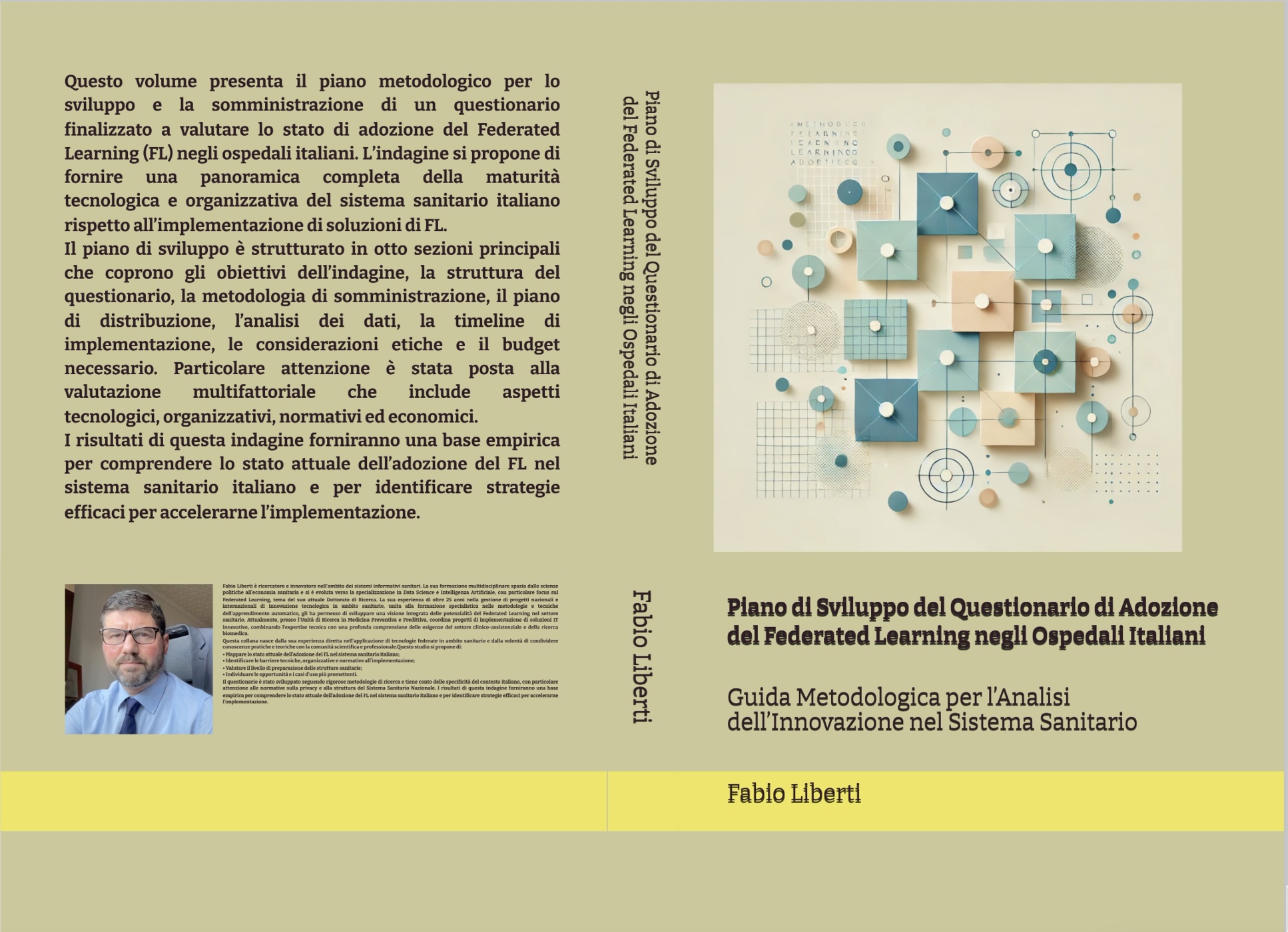
Study plan of the Questionnaire for the adoption of federated learning in Italian hospitals.
Methodological guide for the analysis of innovation in the healthcare system.
In preparation — no publication date set
A methodological guide is in preparation that explores the implementation of federated learning within Italian healthcare institutions. Based on our ongoing research and practical experiences, this publication will provide deep insights into:
- Privacy-Preserving Machine Learning Architectures
- Technical Implementation Guidelines
- Real-world Case Studies from Italian Healthcare Network
- Best Practices & Future Directions
Participate in Our Ongoing Research
Share your institution's perspective on federated learning adoption in healthcare
Join the StudyCurrent Research Focus
The research line rests on a doctoral programme in federated learning for digital health, built on more than 7,900 controlled experiments across seventeen aggregation algorithms and several clinical datasets. Four questions organise the work.
Architecture under heterogeneity
How to design federated systems that hold when hospital nodes differ in data distribution, infrastructure and participation — and how to measure what each design choice costs.
Multidimensional governance
Which governance models reconcile technical innovation, regulatory compliance under GDPR and the European Health Data Space, economic sustainability and ethical principles — treated together, not in sequence.
Conditions for adoption
Which barriers and enabling conditions govern the adoption of federated learning in Italian hospitals: technological, organisational, cultural. The finding that recurs is that the binding constraint is rarely the technology.
Interoperability
How federated learning integrates with HL7 FHIR and the OMOP Common Data Model, and what remains between an architecture aligned by design and one certified as compliant.
A strand that runs across all four: equity of outcome
Average accuracy can conceal a diagnostic class that collapses, or a small hospital that pays the cost of the federation. The work proposes a dedicated measure — the Diagnostic Equity Index — alongside established concentration indices, and treats the gap between the average and the worst case as a result in its own right.
Publications
Peer-reviewed output of the FENITH research line, most recent first:
FL-EHDS
A Privacy-Preserving Multimodal Federated Learning Framework for the European Health Data Space
🔗 DOI 10.1109/FLICS70075.2026.11621929Federated Learning in Dynamic and Heterogeneous Environments
Advantages, Performances, and Privacy Problems — with D. Berardi and B. Martini
🔗 DOI 10.3390/app14188490Distributed Artificial Intelligence and Health Governance
A Multidimensional Analysis of the Tensions Between Rules, Ethics and Innovation — first author
🔗 aisel.aisnet.org/itais2025/23Federated Health Data Platforms
Transforming Clinical Silos into Economic Assets: Business Models for European Digital Health Research Networks
🔗 DOI 10.5281/zenodo.17557015Explainable Federated Learning for Secure Telemedicine
Protecting Patient Identity through Privacy-Preserving Deepfake Detection — with R. Fanale and V. Stile
🔗 Institutional repositoryProject Presentation
FENITH: A Privacy-Preserving Federated Learning Framework for Italian Healthcare Network
📄 View PresentationAccepted and awaiting publication: FedHR5.0 — A Human-Centric Federated Learning Framework for Organisational Learning and Workforce Competency Development in Healthcare (IFKAD 2026); Federated Learning and EHDS as Policy Data Infrastructure for Territorial Health Planning in Ageing Europe (ICSIS 2026).
Education
The research line has a teaching counterpart: the material developed for FENITH is carried into structured courses and seminars.
Seminar cycle — CSFL
Federated Learning for Digital Health: eight meetings, 22 hours, from the foundations to governance and evaluation. Proposed programme, available for activation by universities, doctoral schools and healthcare organisations.
🔗 ProgrammeUniversity courses
Two 6-credit courses of 32 lessons each — Federated learning for non-centralisable data and H-Health and the role of ICT in health system management — with three training modules for executive education.
🔗 Teaching proposalReference text
Quaderni di Studio su Federated Learning — a five-volume series. Volume 1, Fondamenti Teorici e Architetture, is in press; the remaining volumes are in preparation.
🔗 Series pageMedia
FENITH’s home is this site. The channels below extend it; those still being populated are marked as such.
GitHub
Open-source repositories and technical documentation. Being populated — first releases upcoming.
github.com/FENITH-Labs/FENITHDiscussion group on federated learning in healthcare — 47 members. The group carries the differentiated name, an earlier homonym holding fenith.
linkedin.com/fenithYouTube
Technical presentations and project demonstrations. Channel open, first recordings upcoming.
youtube.com/@FENITH-LabsTeam
FENITH is coordinated by:

Fabio Liberti
Founder and Coordinator
PhD in Big Data and Artificial Intelligence. Leads the development of privacy-preserving federated learning solutions for healthcare networks. ORCID 0000-0003-3019-5411.
Join Our Research Network
We welcome collaboration with healthcare institutions and research centers interested in advancing medical research through federated learning.
Email us at: research@fenith.org
Contact Us